
Overview
Children and young people are different from adults. They are continually developing physically, emotionally and psychologically. Due to the physiology and biomechanics of growth, young people show a unique set of age related symptoms. Whilst many conditions seen in childhood are self-limiting; some more serious pathology can occur. As a specialist Musculoskeletal Physiotherapy team we hope that you find the information on our website helpful, but if the pain your child is experiencing does not improve please seek further medical advice and if its deemed appropriate your GP can refer your child to our physiotherapy service.
Back Pain
Back pain in children (especially young children below the age of 6 years) is much more unusual than it is in adults, and can be worrying for parents. While there are certainly serious causes of back pain, the vast majority of children with back pain have symptoms that result from muscle or ligament injury, without any structural abnormality.
Some back pain warning signs that may indicate a more serious problem include:
- Night pain (especially pain that awakens your child from sleep)
- Constant symptoms of pain
- Symptoms of generalized illness (fever, chills, malaise, weight loss)
- Symptoms persisting beyond several weeks
- Symptoms in very young children
- Leg pain, numbness or weakness
- Trouble walking
- Bowel or bladder problems
These warning signs don’t necessarily mean there is a more serious problem, however, they are a good screening test to determine if more evaluation should be pursued. For example, muscular back pain can persist for months, however, if the symptoms have been going on for a couple of weeks, it’s best to ensure the diagnosis is clear and seek advice from either your GP or physiotherapist.
When a more serious cause of back pain in your child has been eliminated by a medical professional, other contributing factors need to be considered. Non-specific back pain in children may be caused by any combination of any of the below factors;
Causes of Back Pain
Spending too much time in any one position is not good for our backs. The saying ‘your next posture is your best posture’ is a good one to remember. This phrase emphasises the importance of keeping moving and limiting the time spent in one position. Get your child to set timers to remind them to move or limit the time spent on one sedentary activity to 30 minutes. Try to switch inactivity for activity. Remembering any movement is better than no movement.
Homework should be done at a desk or table that ideally has an adjustable chair that can be positioned to suit the child.

Technology is definitely here to stay. Help your child understand when relaxing watching TV or playing on consoles a good supportive chair placed directly in front of the screen (rather than at an angle) will help improve posture and again the importance of limiting time in one position and to move regularly.
Click here to view information from the NHS on the common posture mistakes and fixes.
There are a number of reasons obesity contributes to back pain in both children and adults. If your child is carrying extra weight especially around their middle it can cause changes in their posture that increases stress in their lower back region. It is also an indication that your child does not have the correct balance between exercise levels and the number of calories they are consuming. Inactivity, obesity and back pain are often interrelated.
Take a look at the links below for further information
NHS Change4Life – Childs weigh information
Keeping your child happy and stress-free is often easier said than done, but mental health difficulties and low mood are known to be associated with back pain. If you are concerned about your child’s mental health it is important to speak to a GP.
Non-specific causes of neck pain in children
Like back pain, neck pain in children is not common, especially children under 6 years. While there are certainly serious causes of neck pain, the vast majority of children with neck pain have symptoms that result from muscle or ligament injury, without any structural abnormality.
Please seek medical advice from your GP or physiotherapist if your child has any of the below symptoms, as they can be a warning sign that there may be a more serious problem:
- Night pain (especially pain that awakens your child from sleep)
- Constant symptoms of pain
- Symptoms of generalized illness (fever, chills, malaise, weight loss)
- Symptoms persisting beyond several weeks
- Symptoms in very young children
- Headaches &/or visual disturbances
These warning signs don’t necessarily mean there is a more serious problem, however, they are a good screening test to determine if more evaluation should be pursued. For example, muscular neck pain can persist for months, however, if the symptoms have been going on for a couple of weeks, it’s best to ensure the diagnosis is clear and seek advice from either your doctor or physiotherapist.
Non- specific Neck Pain in Children
When a more serious cause of neck pain in your child has been eliminated by a medical professional, other contributing factors need to be considered. Non-specific neck pain in children may be caused by any combination of any of the below factors.
Causes of Neck Pain in Children
Encourage regular movement and changes of posture and positioning.
School bags that are too heavy or carried poorly are often a cause of neck pain in children. Make sure they are not too heavy and the weight is equally distributed (for example, by carrying the backpack on two shoulders rather than one). If a locker is available, encourage your child to use it.
Homework should be done at a desk or table that has a chair that can be adjusted in height to suit the child.
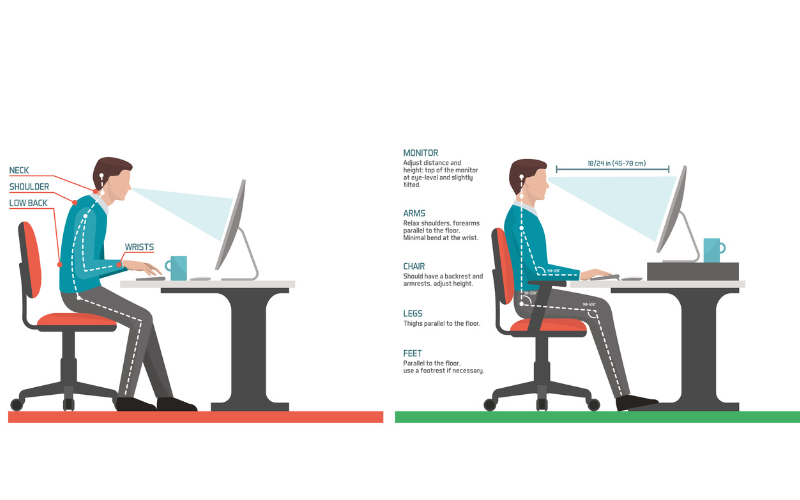
When relaxing watching TV or playing on consoles a good supportive chair placed directly in front of the screen (rather than having to turn your head to the side) will help improve posture. Encourage your child to take regular breaks and move regularly.
There are a number of reasons obesity contributes to neck pain in both children and adults. If your child is carrying extra weight it can cause changes in their posture that increases stress in the neck region. It is also an indication that your child does not have the correct balance between exercise levels and the number of calories they are consuming. Inactivity, obesity and neck pain are often interrelated.
NHS Change4Life – Childs weigh information
Keeping your child happy and stress-free is often easier said than done, but mental health difficulties are known to be associated with neck pain. If you are concerned about your child’s mental health it is important to speak to a GP.
Knee Pain
If your child has experienced trauma related onset of knee pain i.e. knee pain that started after a trip, slip, fall or contact with another person or object, and there is immediate swelling and bruising that occurs within 20 minutes of the injury, then we would recommend you seek immediate advice from a medical professional.
If your child is experiencing knee pain that was brought on by trauma, but without immediate swelling and bruising, but the pain has persisted for more than a few weeks without showing signs of improving, we would also recommend seeking expert medical advice. In most cases we would expect such injuries in a fit and healthy child to settle within a few weeks with appropriate rest, ice and if required elevation.
If your child starts experiencing knee pain without a known mechanism of injury and there is swelling, redness or increased temperature to the area, please seek medical advice.
If your child starts experiencing knee pain without a known mechanism of injury and it does not get better within a few weeks, again seek medical advice.
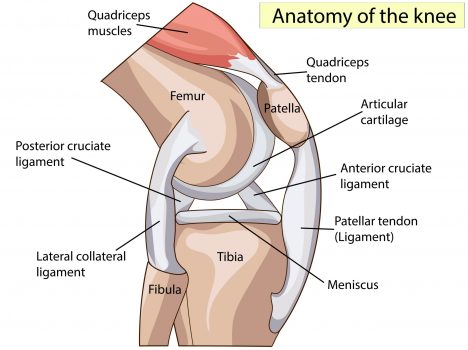
Anterior Knee Pain
Anterior knee pain is a common term used to describe pain at the front centre of the knee. It should not be confused with pain located in the upper shin bone (just below the knee cap) because this is a different condition called Osgood Schlatter’s disease, and there is often an associated bony lump.
Anterior Knee pain can also sometimes be referred to as Chondromalacia Patellae or Patella Femoral pain syndrome. It can occur in both children and adults, but is common in adolescents, especially around periods of rapid growth or with increased sports participation. It is more common in girls than boys. It often occurs in both knees, but can affect just one.
It can often be difficult to give one particular explanation for Anterior Knee pain. It is not usually caused by a defect in the knee, but may be due to;
- an imbalance in muscles around the knee
- weakness in muscles around the knee
- tightness in the quadriceps and hamstring muscles
- altered bio-mechanics (poor alignment of hips, knees, ankles & feet)
- an overuse injury caused by high intensity training
- poor footwear
- poor running technique
The pain will usually come on gradually and be described as a dull ache. It is often made worse by certain activities such as running, jumping, walking down stairs or a steep hill.
In most cases Anterior Knee pain will settle with rest, ice or simple analgesia. It is also important to ensure good supportive footwear is worn especially school and sports shoes. However, if the pain persists beyond a few weeks then you should contact your GP or Physiotherapist and they can assess the area. They may give some exercises to help strengthen and/or stretch specific muscles.
Exercises that may help:
Quads Stretch
Hip flexor stretches
Squats
SLR
Lunges
Osgood Schlatter’s Disease (OSD)
OSD is a common cause of knee pain in children and adolescents, especially those that are very physically active and do a lot of running, jumping or kicking sports.
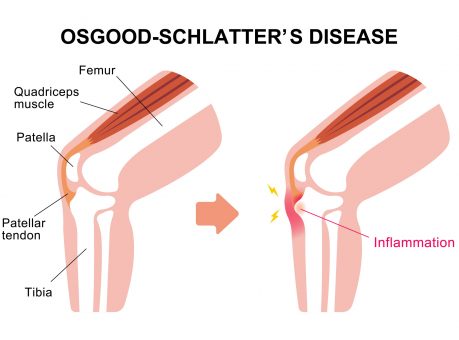
OSD is caused by swelling and irritation of the growth plate at the top of the shin bone. Growth plates occur at the end of bones and as the name indicates, it is where the bone grows from. When the young person reaches skeletal maturity (stops growing) the growth plate fuses and no more growth occurs. This process is usually complete by the age of 25 years, but can vary significantly and usually occurs earlier in girls than boys. The pain is caused by a sudden growth spurt in a physically active child. During a period of rapid growth, the bones, muscles and tendons can grow at different rates. In OSD, the tendon that connects the shin bone to the kneecap pulls on the growth plate at the top of the shin bone (just below the kneecap). It is this pulling that causes the pain and irritation associated with OSD. In some cases, the repeated pulling on the soft growth plate bone causes it to bulge and can be felt as a hard lump under the skin in the area.
OSD typically causes pain and swelling below the kneecap. The pain usually gets worse with running, jumping, going up stairs, and walking up hills. Severe pain may lead to limping. OSD can happen in one or both knees. OSD rarely causes any long-term knee problems that continue into adulthood, because once the child stops growing the muscles ‘catch up’ with the bone growth and the growth plate hardens, both of which result in the cessation of the traction and irritation.
Young people with OSD can carry on playing sport and being active if they can tolerate the pain associated with it. If, however the pain is causing a limp then it is sensible to rest until the pain settles. This will often take a couple of days, they can then resume sport as pain allows.
OSD will usually be eased by;
- Rest
- Ice or cold pack on knee every few hours for 15 min at a time. Put a thin towel between the ice and knee to protect the skin from an ice burn
- Stretches of the quadriceps especially before and after sport and more regularly during growth spurts ADD STRETCH
- Non steroidal anti – inflammatory gels may also be helpful.
Foot & Ankle Pain
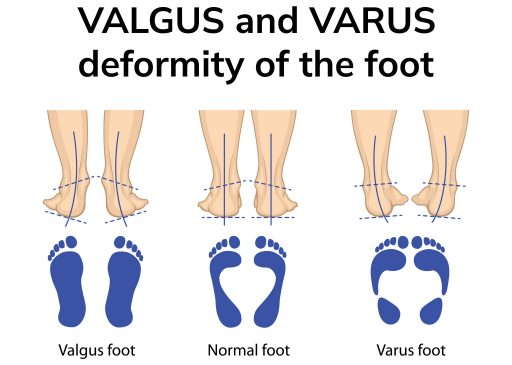
If your child is experiencing foot and/or ankle pain, and you are not sure why, have a good look at their shoes. Good supportive shoes and trainers can make a big difference to aches and pains in hips, knees, ankles and feet. This is especially true if your child does not have ‘neutral’ biomechanics. By this we mean optimal alignment of their legs and feet. Sometimes this is quite obvious and sometimes it is subtler. Looking at the soles and wear distribution of your child’s shoes can give some indication.
Issues with the Arch
The arch, or instep, is the middle part of the foot that’s usually raised off the ground when you stand, while the rest of the foot remains flat on the ground. In young children, this arch isn’t always visible because of the baby fat and soft tissue in their feet. It usually develops and appears by the age of 7-9 years old. However, some people never really develop this arch. Sometimes, this is because they inherited lower arches (flat feet) from their parents.
People with flat feet, low arches, or overly flexible arches tend to roll inward, this can twist the foot, leg and knee causing poor alignment and sometimes pain. Flat feet also mean the big toe and one next to it take on more of the effort during the push off part of your step and this can also sometimes lead to pain and the development of bunions in later life.
Many people simply inherit flat feet from their parents, but it can also be aggravated by connective tissue in the foot becoming stretched and inflamed – possibly as a result of overuse, unsupportive footwear, an injury, increasing age, obesity or rheumatoid arthritis. Occasionally, flat feet can be the result of the feet bones not forming properly in the womb or loose connective tissue throughout the body.
Flat feet only need to be treated if you have an associated problem, such as pain or you are concerned your child’s feet are extremely flat (the whole of the foot is in contact with the floor). Non-surgical treatments, such as the recommendation of good supportive shoes and orthotics (in soles) are often recommended in the first instance and in most cases is all that is needed. Surgery is rarely required and only in the most severe of cases.
High arched feet are the opposite to flat feet, and is less common. It can cause the foot to roll outwards so more of the load is going through the little toe and down that outer edge of the foot. This can lead to foot, ankle, knee, hip and back pain.
Often the higher arched foot is associated with tight Achilles tendons and calf muscles, so calf stretches can help. It is important to wear good supportive shoes that have an arch support in them, and in more severe cases orthotics (insoles) to support the arch of the foot may be helpful.
Calcaneal Apophysitis (Sever’s Disease)
Sever’s disease is a painful condition of the heel that occurs in growing children. It happens when the tendon that attaches to the back of the heel (the Achilles tendon) pulls on the growth plate (the apophysis) of the bone of the heel (the calcaneus). The repeated stress on the growth plate causes pain and inflammation at that site. It typically affects children between the ages of 8 and 14 years old.
It is the most common cause of heel pain in children, and can occur in one or both feet.
While painful, Sever’s disease is not a serious condition. It will not cause long term damage or arthritis and often resolves once the growth plates close.
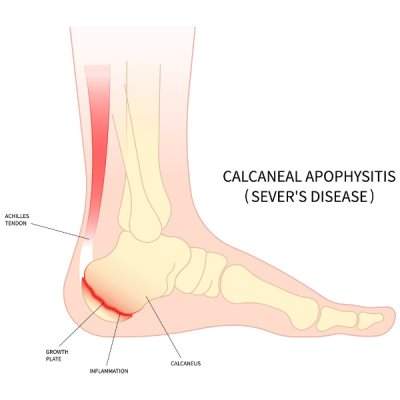
Sever’s disease is more common during periods of rapid growth when the bones grow faster than the tendons. This increases the pull of the tendon on the heel bone. Pre-existing tight calf muscles increase the likelihood of the condition, as does high volumes of impact sports. The heel’s growth plate is sensitive to repeated running and pounding on hard surfaces, resulting in muscle strain and inflamed tissue. Other potential causes of calcaneal apophysitis include obesity and biomechanical problems such as flat foot or a high-arched foot.
Symptoms of calcaneal apophysitis is pain in the back or bottom of the heel. The pain may come and go over a prolonged period of time and often be related to increased activity. The pain may cause children to limp, walk on their toes, difficulty running, jumping or participating in usual physical activities.
Rest: Limit physical activities, especially running and jumping, while having pain. Take rest breaks between activities. If your child is able to keep playing sport it is ok to do so.
Ice: Ice the heel for 15 to 20 minutes when having pain or after activities. Do not place ice directly on skin. Put a towel or other cloth between the ice and the skin.
Footwear: Always wear a well-cushioned pair of supportive shoes. Do not walk in bare feet. In some cases, special gel inserts for the shoe called heel cups may help.
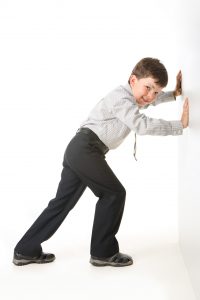
Stretches: Stretching the calf muscles can help loosen tight Achilles tendons and help decrease the pull of the tendons on the growth plates.
Hold each stretch for 30 seconds. Repeat 10 times. Try and do this stretching 3x a day – when you get up in the morning, when you get home from school and before bedtime.
Recovery from Sever’s disease varies from patient to patient. In most cases, Sever’s disease goes away on its own with rest, treatment, and time. Symptoms may worsen if your child tries to play through the pain but this should not cause any long-term problems with the foot or ankle. The pain may come and go over a period of years (typically between the ages of 8-14 years). However, the pain should not continue beyond fusing of the growth plate. Your child should continue with calf stretches regularly to try to help prevent re-occurrences.
Shoulder Pain
The shoulder joint is a complex joint that combines many bones, tendons and muscles in order to allow a large range of motion of the arm. The large range of motion of the shoulder makes it more susceptible to injury, which can cause shoulder pain. Your child may feel pain only with certain movements, such as throwing a ball or it may be more constant pain.
What causes shoulder pain?
Shoulder pain usually involves the soft tissues of the shoulder, which include the muscles, ligaments and tendons, rather than bones. Another common cause of shoulder pain is traumatic injury, which can lead to shoulder instability, commonly called a dislocated shoulder when the shoulder moves out of its normal position.
Types of Shoulder Pain in Children
A dislocated shoulder happens when your upper arm pops out of your shoulder socket. The shoulder is one of the easiest joints to dislocate because the ball joint of your upper arm sits in a very shallow socket. This makes the arm extremely mobile and able to move in many directions, but also means it is not as stable as some other joints. After a shoulder dislocation you will usually be able to resume most activities within 2 weeks but should avoid heavy lifting and sports involving shoulder movements for between 6 weeks and 3 months. You should usually be referred to physiotherapy after an injury of this kind and your physiotherapist will advise you regarding when you can return to all activities.
How a dislocated shoulder happens
You can dislocate your shoulder if you fall on to your arm heavily. Most people dislocate their shoulder while playing a contact sport, such as rugby, or in a sports-related accident. Shoulder dislocations can happen more easily in people who are highly flexible, such as those with loose joints (joint hypermobility).
Have I dislocated my shoulder?
If you suspect, you have dislocated your shoulder it is usually obvious because:
- you will not be able to move your arm and it will be very painful.
- your shoulder will suddenly look different compared to the other side or how it usually looks.
What to do with a dislocated shoulder
Go to your nearest accident and emergency (A&E) department immediately if you think you’ve dislocated your shoulder. Do not try to pop your arm back in yourself – you could damage the tissues, nerves and blood vessels around the shoulder joint. While waiting for medical help, avoid moving your upper arm as much as possible.
Once the shoulder has been relocated by a professional you should be referred to physiotherapy for rehabilitation.
https://www.nhs.uk/conditions/dislocated-shoulder/
- Tendonitis: A tendon connects muscle to bone or other tissue and has a cord or band-like quality. Tendonitis is often a result of the wearing process of the tendons that takes place over a long period of time, but it can also be caused from overuse or high-intensity sports. The rotator cuff is the unit of muscles and tendons that provides shoulder motion and stability; it is the most common area for tendonitis.
- Bursitis: Excessive use of the shoulder can lead to inflammation and swelling of a bursa. Bursas are fluid-filled sacs located near friction areas in the joint that lessen the friction caused by movement of the shoulder. The condition known as bursitis can limit the range of motion of the shoulder because of pain.
Both tendonitis and bursitis injuries in children are rare, and will almost always be associated with a sport or activity that puts an increased amount of stress or strain on the shoulder region. Rest from the aggravating activity will usually settle down the pain. Even rarer causes of shoulder pain are tumour’s, infection or nerve-related problems. If you suspect any of these causes of shoulder pain in your child seek advice from a paediatric musculoskeletal physiotherapist.
Useful Links
- For further information on posture mistakes and fixes click here.
- Click here to find out facts about what food you are eating
- Find out if your child is at a healthy weight
- Guidance on the types and amount of physical activity children should be completing to stay healthy.
- Take a look at some fun exercise activities you can do at home you’re your children
Service update
The Mid and South Essex Physiotherapy Service is now delivered by multiple providers. Please use the links below to find the information or service you need.